Desirable Properties of Decomposition –
If we apply the normal forms or normalization or schema refinement technique – Decomposition to the universal table, then it may be splitted up into different fragments.
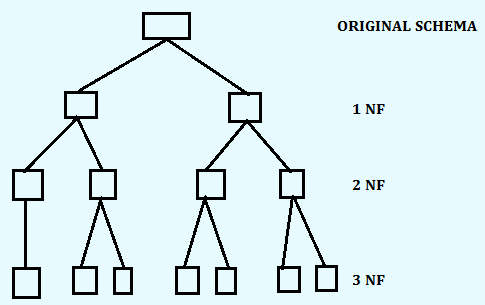 At any stage, if we combine the fragments (denormalization), it should give the original table in terms of columns and rows and it will be described as the following properties :
Lossless Join Decomposition
Let R be the relational schema with instance r is decomposed into R1,R2,….,Rn with instance r1,r2,…..,rn. If r1 ⋈ r2 ⋈ ……. ⋈ rn = r , then it is called Lossless Join Decomposition. i.e. if natural joins of all the decompositions gives the original relation, then it is said to be Lossless Join Decomposition.Another Definition or To check whether a Decomposition is a lossless or lossy decomposition –
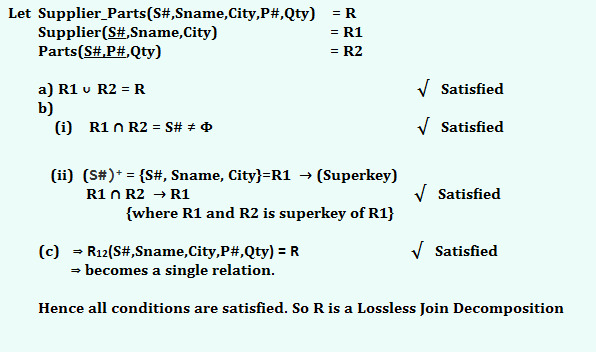
Let R be a relation schema, F be a set of functional dependencies on R. Let R is decomposed in R1, R2,….,Rn. The decomposition is a lossless-join decomposition of R if(a) R1 ∪ R2 ∪ ......∪ Rn ≡ Rand (b) Let Ri and Rj be the any two subrelations, Ri and Rj can be merge into single relation Rij with attribute set Ri ∪ Rj only if (i) Ri ∩ Rj ≠ Φ
(ii) Ri ∩ Rj → Rj {Ri and Rj should be super key of Ri} and Ri ∩ Rj → Ri {Ri and Rj should be super key of Rj} (c) Repeat (a) untin N relations become single relation. If is possible to merge into single relation, then decomposition is losless, otherwise lossy.
Example : How to Find Lossless Join Decomposition –
Method 1 : (Not Useful for Gate Students)
Consider the previous example Supplier_Parts which is decomposed into supplier and parts relation but doing the decomposition in a different way :|
Supplier_Parts :
|
|||||||||||||||||||||||||||||||||||||||||||
| ⇓ | |||||||||||||||||||||||||||||||||||||||||||
|
Parts :
|
Supplier :
|
||||||||||||||||||||||||||||||||||||||||||
Parts ⋈ Supplier
|
Parts ⋈ Supplier :
|
= Supplier_Parts |
Method 2 : (Useful for Gate Students)
The above method is very time consuming for the gate students. The method 2 is very simple and fast. → Consider again the relation Supplier_Parts. Try to decompose the relation so that the common attribute in the tables is a key for atleast one table. Here,In Supplier relation Supplier(S#,Sname,City): S# → Sname S# → City In parts relation Parts(S#,P#,Qty) : (S#,P#) → Qty
 ]]>
]]>