Components of Database – A database system involves four major components –
- Data
- Hardware
- Software
- Users
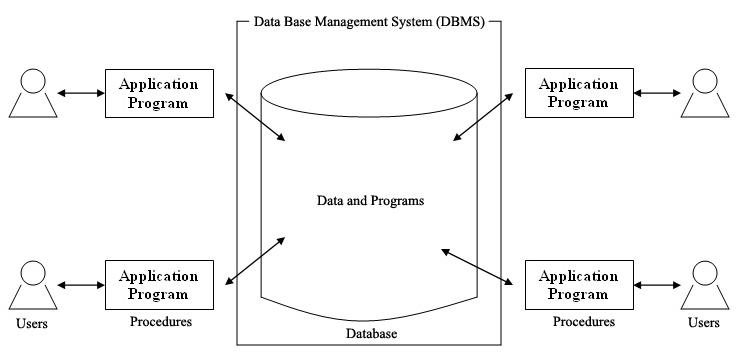 (Components of Database)
Data –
Data stored in database system is partitioned into one or more database. A database is both integrated and shared.- By Integrated, means that database can be thought as unification of several distinct data files with redundancy partially or wholly eliminated.
- and By Shared means that, same piece of data in database may be shared among several users for different purposes.
Hardware –
Hardware consists of secondary storage volumes like disks, drums, etc on which database resides, together with associated devices, control units etc.Software –
A software layer is in between the hardware and the users, and the software is usually called database management system (DBMS). It also includes operating system, network software(if necessary), application programs. All requests from users for accessing the data from database are handled by softwares.Database Users –
There are 3 classes of user-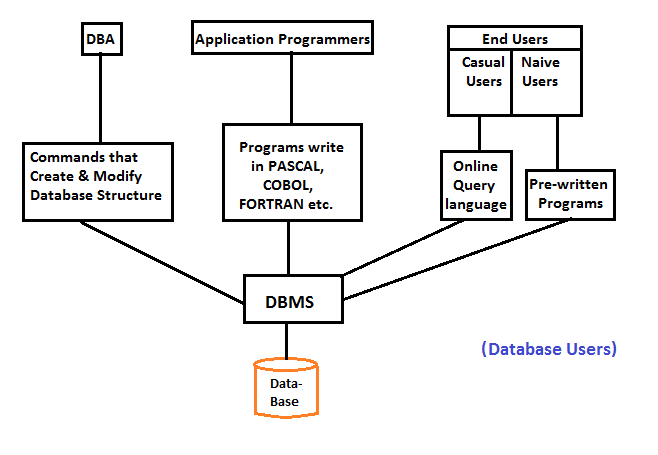
- Application Programmer – (is responsible for writing application programs typically in a language such as COBOL or PL/1 that use the database for retrieving,creating, deleting or modifying information)
- End Users – access the database from a terminal. There are two types of end users-
- Casual users – These users are trained in the use of the on-line query language and access data by entering queries at terminals.
- Naive Users – These users access database through application programs. They do not need to know the structure or language of database systems.
- Database Administrator (DBA) – is a person or group of persons responsible for overall control of database.
Functions Of DBA (Database Administrator) –
- Deciding the information contents of database system
- Deciding Hardware device to be used
- Deciding the users and the data to be used by them.
- Deciding the backup and recovery method
- deciding the validation checks on the data
- Responsible for Monitoring Performance and making the appropriate adjustments as requirements change.
| Previous | Home | Next |
| Advantages and Disadvantage of DBMS | Execution Steps of DBMS |
]]>